.png)


.webp)
Understanding Specific Learning Disabilities

A child might explain a brilliant idea out loud, then write only two sentences. They might understand a story when it is read to them, but struggle to read the words independently. Or they might follow a maths discussion, then become lost when numbers appear on the page.
These patterns do not mean a child is lazy, careless or less intelligent. Sometimes they are signs of a specific learning disorder, a neurodevelopmental condition that causes persistent difficulty learning and using particular academic skills.
Specific learning disorders can affect reading, written expression, mathematics, or more than one area. Dyslexia, dysgraphia and dyscalculia are familiar terms for these patterns, although Australian health professionals commonly use the formal diagnostic descriptions below.
What is a specific learning disorder?
A specific learning disorder is an ongoing difficulty with academic skills that is more substantial than the everyday ups and downs of learning. The difficulty begins during the school years, although it may become clearer later when work becomes faster, longer or more complex.
The word specific matters. It describes the academic skill affected, not the whole child. A child can have a rich vocabulary, original ideas, strong curiosity or practical problem-solving skills and still find reading, writing or maths unusually difficult.
Specific learning disorders are not diagnosed simply because a child is behind. Missed schooling, limited opportunity to learn, language background, hearing or vision concerns, intellectual disability and other developmental or emotional factors can also affect school performance. A careful assessment considers the complete picture.
Three common learning patterns
Reading difficulties and dyslexia
Dyslexia is commonly used to describe a specific learning disorder with impairment in reading. A child may have persistent difficulty reading words accurately or fluently, decoding unfamiliar words, or spelling. Reading comprehension can also be affected, especially when so much effort is spent working out the words.
Signs can include slow or effortful reading, guessing from the first letter or picture, difficulty matching sounds with letters, persistent spelling problems, reading fatigue, or avoiding reading aloud. No single sign confirms dyslexia, and letter reversals alone are not diagnostic.
Recommended Online Course


Written expression difficulties and dysgraphia
Dysgraphia is sometimes used informally for a specific learning disorder with impairment in written expression. The difficulty may involve spelling, grammar and punctuation, sentence construction, or organising ideas clearly in writing.
A child may tell an imaginative story but struggle to get it onto paper. Their writing might be much shorter or less organised than their spoken answer, even when they understand the topic. They may need far more time than classmates to plan, write and edit.
Handwriting and written expression are related but not identical. A child who has difficulty only with handwriting or fine-motor control may need assessment for a motor or coordination concern rather than a specific learning disorder in written expression. For general ideas that encourage handwriting and creative expression at home, see our guide to fostering creativity and handwriting. It is an activity-focused resource, not a guide to diagnosing dysgraphia.
Mathematics difficulties and dyscalculia
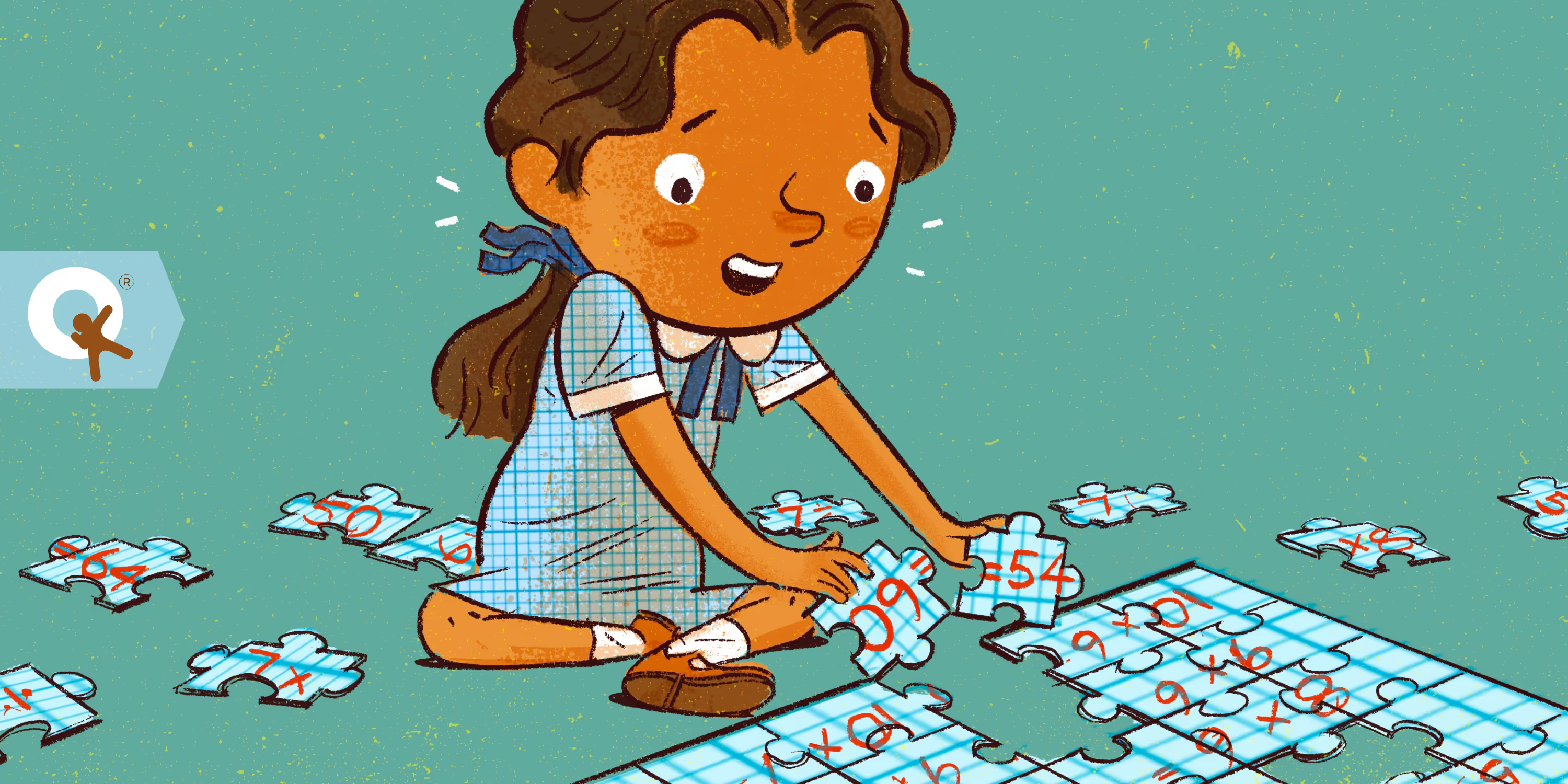
Dyscalculia is commonly used for a specific learning disorder with impairment in mathematics. Difficulties can involve number sense, remembering number facts, accurate or fluent calculation, or mathematical reasoning.
A child might lose track while counting, confuse the value of numbers, rely on slow strategies after peers have become more automatic, forget familiar number facts, or become lost during multi-step calculations. Using fingers is a normal and useful learning strategy. The concern is a persistent pattern that continues to limit progress despite appropriate teaching and practice.
Signs are clues, not a diagnosis
Learning difficulties can look different across ages, tasks and classrooms. A child may also have more than one affected area, or experience attention, language, slow processing speed, anxiety or other concerns alongside the learning difficulty.
Look for a pattern that is:
- persistent, rather than an occasional difficult week
- specific, affecting particular reading, writing or maths skills
- unexpected in the context of the child’s opportunity to learn and other abilities
- impactful, affecting progress, participation, confidence or everyday schoolwork
- still present after targeted support, even if the child has made some progress
Parents do not need to wait for a diagnosis before asking the school to identify the skill gap and provide targeted teaching.
Further Reading

How are specific learning disorders assessed?
A child psychologist with relevant assessment experience may assess a specific learning disorder by combining test results with the child’s history, school information and response to instruction. No questionnaire, IQ score or academic test establishes the diagnosis on its own.
Depending on the referral question, an educational assessment may include:
- discussion with parents or carers about development, health, language and family history
- teacher information, school reports, work samples and previous assessment results
- details of the teaching and targeted intervention already provided, including how the child responded
- standardised assessment of relevant reading, spelling, writing or mathematics skills
- observation of how the child approaches, persists with and responds to academic tasks
- consideration of hearing, vision, language background, attendance, educational opportunity and other conditions
- cognitive assessment when it is clinically relevant to the referral question, rather than as an automatic requirement
The WIAT-III A&NZ is one measure a psychologist may use to understand academic strengths and difficulties. It is interpreted with the other assessment information, not treated as a stand-alone diagnosis.
What support helps?
Teach the skill directly
Support should match the child’s assessed skill gap. Effective instruction is explicit, structured and carefully sequenced, with modelling, guided practice, feedback and enough repetition to build independence. Reading, writing and maths require different teaching approaches, so one generic program is unlikely to fit every child.
Remove unnecessary barriers
Reasonable adjustments help a child access learning while they continue to receive targeted instruction. Depending on individual need, these might include audio or text-to-speech access, speech-to-text, scaffolded writing, reduced copying, clear worked examples, additional time, or an alternative way to demonstrate knowledge.
Under the Australian Disability Standards for Education, education providers must support students with disability to access and participate in education on the same basis as students without disability. Adjustments should be discussed with the child and family, selected for the individual and reviewed over time. A diagnosis does not automatically determine one particular adjustment, support person or funding outcome.
Protect confidence and curiosity
Repeated difficulty can leave a child feeling that school is a test they keep failing. Notice the effort hidden behind the work. Separate academic performance from intelligence, avoid comparisons with siblings or classmates, and make room for the activities in which the child feels capable, connected and curious.
BriteChild® Mental health care for Kids.
Personalised care for kids, trusted guidance for parents—anytime, anywhere in Australia.
.avif)
What parents can do next
- Talk with the teacher. Ask which specific skills are difficult, what has already been taught and what progress data shows.
- Check the foundations. Discuss hearing, vision, language, attendance and any health, attention or emotional concerns that may affect learning.
- Start targeted support. Ask for teaching that directly addresses the identified reading, writing or maths skill. Support can begin before formal diagnosis.
- Keep useful records. Save school reports, work samples, intervention plans and progress results. They help show the pattern over time.
- Consider assessment. If difficulties persist despite appropriate support, a child psychologist can help clarify the learning profile and next steps.
When to speak with a child psychologist
Consider seeking advice when a learning difficulty is persistent, affects progress or confidence, or remains unclear after discussion and targeted support at school. The aim is not simply to attach a label. It is to understand what is getting in the way and what the child needs next.
Quirky Kid’s child psychologists can discuss whether an educational assessment is appropriate for your child. Learn more about our educational assessment process or book an initial consultation.
View article references

Australian Government Department of Education. Disability Standards for Education 2005. https://www.education.gov.au/disability-standards-education-2005
Espinas, D. R., Vaughn, S., & Fuchs, L. S. (2025). Interventions for children and adolescents with specific learning disability and co-occurring disorders. Pediatric Research, 98, 2536–2544. https://pubmed.ncbi.nlm.nih.gov/40681698/
Healthdirect Australia. Learning disabilities. https://www.healthdirect.gov.au/learning-disabilities
NSW Department of Education. (2025). What Works Best 2025: Evidence guide for excellent schools. Chapter 2: Explicit teaching. View the evidence guide.
Pearson Clinical Assessment Australia & New Zealand. WIAT-III A&NZ. Official product information.
Raising Children Network. (2024). Learning difficulties and specific learning disorders. https://raisingchildren.net.au/school-age/school-learning/learning-difficulties/learning-disabilities-signs-and-support
SPELD NSW. Specific Learning Disorder with Impairment in Written Expression. https://www.speldnsw.org.au/information/dysgraphia/

Related Products


Subscribe to our Newsletter

